An acre is 43,560 square feet: a little over half a football pitch
Published on
An acre is 43,560 square feet: 4,046.86 m² or 0.4047 hectares, a little over half a football pitch. Acres to hectares table, where it comes from (a day of ploughing with oxen) and why the number is so odd.
See other amounts
An acre is 43,560 square feet: 4,046.86 square metres, or 0.4047 hectares. That is a little over half a football pitch, or about three quarters of an American football field. Going the other way, a hectare is 2.47 acres. It is how land is measured in the United States and, informally, in the UK, Canada and India.
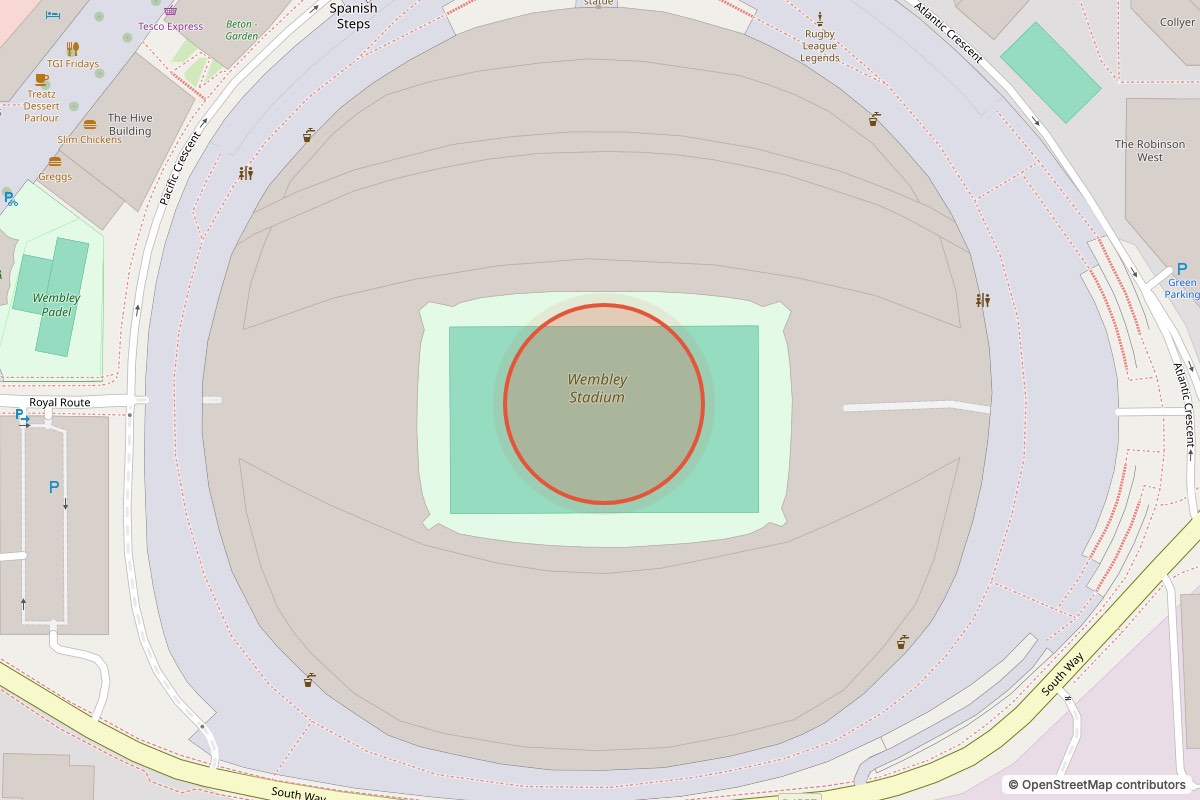
The circle on the map is one acre drawn on the Wembley pitch: it covers just over half of it. Drag it to your own street to compare it with a place you know. This article is part of area units and where they come from; if you only want the number, the area converter turns acres into hectares, square metres or square feet.
An acre in things you know
- 57% of a football (soccer) pitch of 105 × 68 metres. The other way round, a pitch is 1.76 acres.
- About 76% of an American football field including the end zones (the full field is 1.32 acres), or 91% of the field between the goal lines.
- A square 208.7 feet (63.6 metres) on each side, or a circle with a radius of 117.8 feet (35.9 metres), which is what the map draws.
- About 15 and a half tennis courts (a doubles court is 78 × 36 feet).
- Less than half of a hectare: almost two and a half acres fit in one hectare.
Acres to hectares: the quick table
To turn acres into hectares, multiply by 0.4047 (or, in your head, divide by two and a half). The round figures link to that area drawn on a map:
| Acres | Hectares | To picture it |
|---|---|---|
| 1 acre | 0.40 ha | A little over half a football pitch |
| 5 acres | 2.02 ha | Like 2 hectares |
| 10 acres | 4.05 ha | Like 4 hectares |
| 50 acres | 20.2 ha | Like 20 hectares |
| 100 acres | 40.5 ha | Winnie-the-Pooh's wood |
| 160 acres | 64.7 ha | A Homestead Act claim |
| 250 acres | 101 ha | Like 100 hectares |
| 500 acres | 202 ha | Like 200 hectares: almost all of Monaco |
| 640 acres | 259 ha | Exactly one square mile |
| 1,000 acres | 405 ha | Like 400 hectares |
| 2,500 acres | 1,012 ha | Like 1,000 hectares |
Where it comes from: a day's ploughing
The acre did not start as a shape but as a day of work: the land a team of oxen could plough in one day. The word comes from Old English æcer, "open field", a cousin of Latin ager and Greek agros — the same root as "agriculture".
That day's work had a definite shape, a ploughed strip. Its length was a furlong (660 feet, 201 metres), the furrow long: how far the oxen pulled before they stopped to rest and turn. Its width was a chain (66 feet, 20 metres). Turning a plough drawn by eight oxen was the hardest part of the day, so fields were made long and narrow. An English statute of around 1300 already puts it that way: forty perches long by four wide.
Hence the odd number: 660 × 66 = 43,560 square feet, or 4,840 square yards. In 1620 the mathematician Edmund Gunter designed the 66-foot, 100-link surveyor's chain so that the sums did themselves: ten square chains make an acre. And because a mile is eight furlongs (which is why it has 5,280 feet), a square mile holds exactly 640 acres.
Why it is exactly 4,046.8564224 m²
The acre is defined from the yard, and since the international agreement of 1959 the yard has been exactly 0.9144 metres. So the acre, without ever changing size on the ground, became a ten-digit metric number: 4,046.8564224 m². Until the end of 2022 the United States also kept a second acre, the survey acre, based on the survey foot: it was about 25 square inches larger, a difference of four parts per million that only mattered when measuring whole states.
The acre that drew the grid of America
The United States parcelled out most of its land west of the Appalachians with a ruler: the Land Ordinance of 1785 divided it into townships six miles square, each split into 36 sections of one square mile, 640 acres. That grid is what you see from the plane when you fly over the Midwest.
The Homestead Act of 1862 gave each settler a quarter section: 160 acres, about 65 hectares. And the most famous broken promise in the country's history was made in acres: the "forty acres and a mule" of General Sherman's field order of 16 January 1865 for families freed from slavery — up to 40 acres each, about 16 hectares. The mule is not in the order (the army lent some later), and President Andrew Johnson reversed it that same year.
Not every acre is the same size
Like every unit that measures work, the acre changed with the ground. The Irish acre was 7,840 square yards (about 6,555 m²) and the Scottish acre about 5,080 m². The same idea turns up across half the world: the Roman iugerum (about 2,500 m²) was what a yoke of oxen ploughed in a day, the German Morgen what could be ploughed in a morning, and the Egyptian feddan (4,200 m²) what a pair of oxen could work.
The exception is the hectare, which came not from the field but from a law: a square 100 metres on each side. An acre is 40% of a hectare.
Where it is still used
In the United States it is the standard unit of land: farms, national parks and wildfires are all counted in acres. In the United Kingdom it stopped being a legal unit for trade on 1 October 1995, yet farmers and estate agents still use it every day. It also survives in Canada, Ireland, India, Pakistan, Ghana and much of the Caribbean. Almost everywhere else, land is measured in hectares.
The acre also gave us a unit of water: the acre-foot, the volume that covers one acre to a depth of one foot — 325,851 US gallons, or 1,233 cubic metres. It is how reservoirs and irrigation rights are measured across the American West.
Famous acres
- Central Park: 843 acres, 341 hectares.
- The Hundred Acre Wood of Winnie-the-Pooh: 100 acres would be 40.5 hectares. The real wood behind it, in Ashdown Forest, East Sussex, is the Five Hundred Acre Wood: 202 hectares.
- Vatican City: about 109 acres, 44 hectares.
- Hyde Park, London: 350 acres, 142 hectares.
Frequently asked questions about the acre
- How big is an acre?
- An acre is 43,560 square feet, or 4,046.86 square metres (0.4047 hectares). As a square it is 208.7 feet (63.6 metres) on each side: a little over half a football pitch.
- How many acres are in a hectare?
- A hectare is 2.471 acres, and an acre is 0.4047 hectares. To convert in your head, divide acres by two and a half: 100 acres is about 40 hectares.
- How many football fields is an acre?
- An acre is 57% of a standard football (soccer) pitch of 105 × 68 metres, and about 76% of an American football field including the end zones. A soccer pitch is 1.76 acres; an American football field is 1.32 acres.
- Which is bigger, an acre or a hectare?
- The hectare, by almost two and a half times: a hectare is 10,000 m² and an acre is 4,046.86 m². An acre is roughly 40% of a hectare.
- Why is an acre 43,560 square feet?
- Because it is a furlong (660 feet) by a chain (66 feet): the shape of a strip of ploughed land, as long as the oxen could pull a furrow before resting. 660 × 66 = 43,560. It was the land a team of oxen ploughed in a day.
- How many acres are in a square mile?
- Exactly 640. A mile is eight furlongs and an acre is one furlong by a tenth of a furlong, so a square mile holds 8 × 80 = 640 acres, which is 259 hectares.
Want to see any number of acres? Turn it into hectares with the area converter and type it into the Hectareometer: it is drawn to scale over your own city. Or measure a plot by drawing it on the map yourself. The whole story — the hectare, the acre and why almost every land unit measures a day of work — is in area units.