What is a mile?
Published on · updated on
A mile is 5,280 feet: 1,760 yards, eight furlongs and exactly 1,609.344 metres. From the thousand paces of a Roman legionary to the 1593 statute that stretched it to avoid a tax rise. With a conversion table and drawn to scale on the map.
See other distances
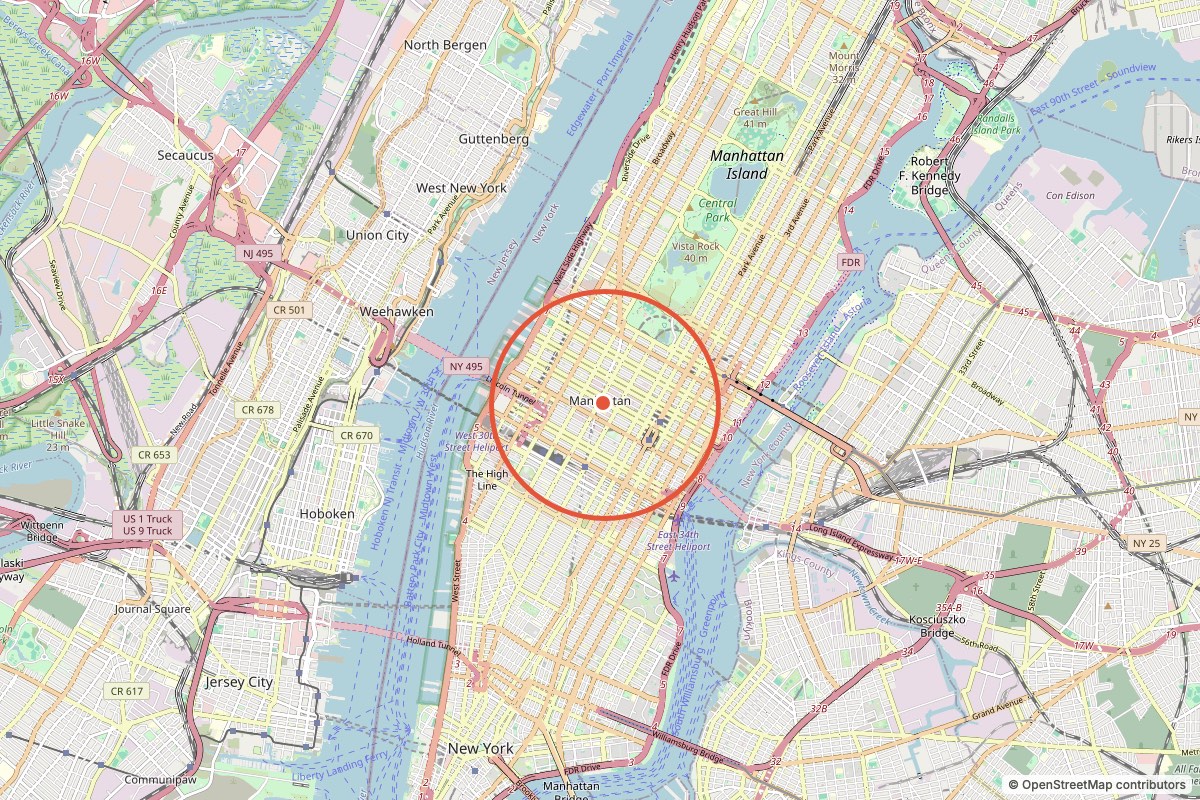
A mile is 5,280 feet: 1,760 yards, eight furlongs, and — since 1959 — exactly 1,609.344 metres. The map above draws that one-mile radius over Times Square; drag it to your own town to see it to scale. If all you want is the number, the distance converter does it instantly.
The interesting thing about the mile is not how long it is, but why it is that long. A kilometre is a thousand metres because somebody decided so in a Paris office; a mile is 5,280 feet because a Roman legionary counted paces, because an ox team stopped to rest every 660 feet, and because in 1593 Parliament worked out that stretching the mile was cheaper than re-measuring England. This article is part of the distance units and where they came from.
The mile is Roman: a thousand paces of a legionary
The name says it. Mile comes from mille passus, “a thousand paces”, and the Roman pace was not a single step but a double step — counted every time the same foot hit the ground again. A thousand of those are 5,000 Roman feet, about 1,479 metres by modern estimates.
It was not a theory: it was how Rome administered an empire. Every mile of road carried a milestone giving the distance and the name of the emperor who had paid for the paving, and hundreds still stand around the Mediterranean. Today's mile is 130 metres longer than that one — 9% longer. England added that 9%, and it had a very specific reason.
Why is a mile 5,280 feet and not 5,000?
Between the Romans and us sits the English field. Farmers did not measure in miles, they measured in furlongs (furrow long): the distance an ox team ploughed before stopping to rest, 660 feet, about 201 metres. A furlong was forty rods of sixteen and a half feet, and every field, every deed and every land tax in England had been measured in rods since Henry VIII.
The trouble is that a Roman mile of 5,000 feet is not a round number of furlongs: it is 7.57. In 1593 a statute of Elizabeth I (35 Eliz. I c. 6) fixed the mismatch the only way that cost nothing: instead of shortening the rod by one eleventh — which would have made every holding in the country “measure” more and pay more tax — it stretched the mile until eight whole furlongs fitted:
8 furlongs × 40 rods × 16.5 feet = 5,280 feet
So the mile is 5,280 feet in order to avoid re-surveying England. The round number in the story is not 5,280 but 8, and it is counted in furlongs, not feet — a unit which, as it happens, does not match anybody's foot either. The precise figure we use today, 1,609.344 metres, is far more recent: it comes from the International Yard and Pound Agreement of 1959, which defined the yard as exactly 0.9144 metres. Ever since then, the mile is defined in metres — an imperial unit measured by the metric system. And the metre, in turn, came out of measuring the Earth's meridian on foot over seven years. They are the two opposite ways of building a unit.
There is no such thing as “the” mile
For centuries “mile” was just the generic word for “a long walk”, and every country tuned it to its own. These are the main ones:
| Mile | How long | Where and when |
|---|---|---|
| Castilian mile | 1,393 m | A thousand paces of five Castilian feet; four of them made a league |
| Roman mile | ≈ 1,479 m | Mille passus: 5,000 Roman feet |
| Statute mile | 1,609.344 m | Today's mile: the UK, the US and little else |
| US survey mile | 1,609.347 m | The surveyor's mile, retired on 1 January 2023 |
| Scots mile | ≈ 1,807 m | 1,976 yards; abolished three times (1685, 1707 and 1824) |
| Nautical mile | 1,852 m | One minute of arc of a meridian; sea and air |
| Irish mile | 2,048 m | 2,240 yards; still on maps into the 20th century |
| Scandinavian mil | 10,000 m | Sweden and Norway, alive today: “two mil away” means 20 km |
Two of those rows deserve a footnote. The Scots mile had to be abolished three times — by the Scottish Parliament in 1685, by the Treaty of Union in 1707 and by the Weights and Measures Act of 1824 — and it still left a mark: Edinburgh's Royal Mile is called that because it is roughly one Scots mile long, which is why it feels longer than it should. And the Scandinavian mil is the classic traveller's trap: when a Swede says something is “a mil away”, that is ten kilometres, not 1.6.
Miles, metres and the countries that kept them
The mile survives on road signs in the United Kingdom, the United States and a handful of territories, and almost nowhere else. Britain is the strangest case: it buys petrol in litres and food in kilograms, but still drives in miles and drinks beer in pints. The United States is stranger still — its mile has been legally defined in metres since the nineteenth century, so the country is quietly metric and does not know it.
Rough conversions worth memorising: a kilometre is 0.62 miles, a bit under two thirds. And beware the runners' shortcut: multiplying miles by 1.6 falls 9 metres short per mile, which is almost 250 metres over a marathon.
What a mile looks like in things you know
- On foot: about twenty minutes at a normal walking pace (3 mph). Ten thousand steps come to 4.7 miles.
- Driving: 70 mph, the British motorway and much of the US interstate limit, is 113 km/h; 30 mph in town is 48 km/h.
- Running: a marathon is 26 miles and 385 yards, and a 5K is 3.1 miles.
- At the beach: the horizon is under three miles away (4.7 km).
- The Indy 500: 200 laps of a 2.5-mile oval, or 804.672 km in total.
The mile in athletics: the imperial unit that refuses to die
In 1976 World Athletics made the metric system its standard and stopped ratifying records at imperial distances, with one exception: the mile. It is still the only non-metric distance with an official world record, and the reason is sentimental — the four-minute barrier. Roger Bannister broke it on 6 May 1954 at Iffley Road in Oxford, running 3:59.4 on a cinder track behind two pacemakers.
Seventy-two years on, the record is aging better than the unit. On 18 July 2026 in London, Britain's Josh Kerr ran 3:42.66 and became the first man under 3:43, erasing the 3:43.13 Hicham El Guerrouj had set in 1999 — a mark that had stood for 27 years. That is an average of 16 mph held for nearly four minutes. The women's record is Faith Kipyegon's 4:07.64, set in Monaco in 2023; her 4:06.42 at Nike's Breaking4 in Paris on 26 June 2025 is the fastest mile ever run by a woman but does not count, because she used male pacemakers and unapproved shoes.
Quick conversion table
| Miles | Kilometres | What it is |
|---|---|---|
| 1 mile | 1.609 km | A twenty-minute walk |
| 3.1 miles | 5 km | The classic fun run |
| 6.2 miles | 10 km | A 10K |
| 13.1 miles | 21.1 km | Half marathon |
| 26.219 miles | 42.195 km | Marathon (26 miles 385 yards) |
| 100 miles | 160.9 km | The classic ultra |
Frequently asked questions about the mile
- How many kilometres is a mile?
- A statute mile is 1.609344 kilometres, or 1,609.344 metres. The other way round, a kilometre is 0.621 miles.
- Why is a mile 5,280 feet?
- Because an English statute of 1593 set it at eight furlongs of forty rods of sixteen and a half feet. Parliament chose to stretch the mile (the Roman one was 5,000 feet) rather than shorten the rod, because every deed and every land tax was measured in rods and furlongs. Its exact metric value, 1,609.344 m, comes from the international agreement of 1959.
- Where does the word mile come from?
- From the Latin mille passus, “a thousand paces”. The Roman pace was a double step — counted each time the same foot landed again — so a thousand paces were 5,000 Roman feet, roughly 1,479 metres. Every mile of Roman road was marked with a stone milestone.
- How many feet and yards are in a mile?
- 5,280 feet, 1,760 yards and 8 furlongs. All three come from the same 1593 statute: the round number is the 8, because the mile was fitted to the furlong and not the other way round.
- What is the difference between a mile and a nautical mile?
- The statute mile is 1,609.344 metres and comes from Roman paces and English farmland. The nautical mile is exactly 1,852 metres and comes from the planet: it is one minute of arc of a meridian. The nautical mile is 15% longer.
- Which countries still use miles?
- Road signs in miles survive in the United Kingdom, the United States and a handful of territories such as the Bahamas, Belize and the Cayman Islands. Everywhere else signs the roads in kilometres, and even in the US the mile is legally defined in metres.
- How long does it take to walk a mile?
- About twenty minutes at a normal pace and fifteen at a brisk one. A recreational runner covers it in eight or nine minutes; the world record is 3:42.66.
Just want the number? Use the kilometers to miles converter. Want to see it? Type a distance into the distances tool and it is drawn to scale over your city, or measure a distance point by point on the map. And if you want the whole story — the metre, the foot, the league and why we still cannot agree — it is in the distance units.