From the foot to the metre: why we measure distance the way we do
Published on · updated on
A kilometre is a thousand metres and a mile is 1,609.344: one of those numbers was chosen and the other was not. The table of every distance unit, the 0.2 mm error still inside the metre, and why a mile is 5,280 feet.
See other distances
A kilometre is a thousand metres. A mile is 1,609.344 metres. The first number is round because somebody chose it; the second one is ugly because nobody did: it piled up over two thousand years, from the paces of a Roman legionary to a treaty signed in 1959. That difference — measuring with the body and with work, or measuring with the planet — is the whole history of distance units.
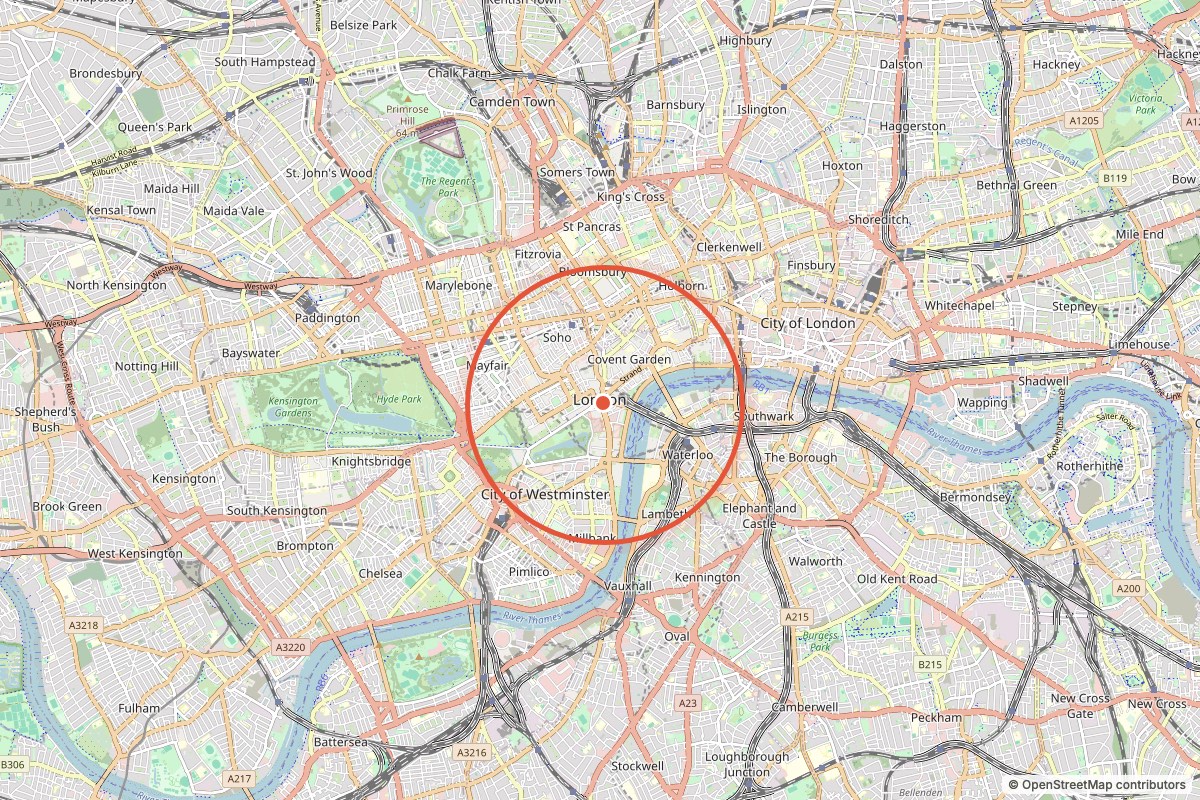
The map above draws a one-mile radius. Compare it with one kilometre: the mile is 61% longer, which is why distances in foreign films, races and road signs never quite line up. If all you want is the number, the distance converter does it instantly.
Every distance unit at a glance
Each row goes to the conversion already worked out, or to the article that tells the whole story:
| Unit | How long | Where it comes from |
|---|---|---|
| Metre | the SI base unit | One ten-millionth of the quadrant of the Paris meridian (1791) |
| Kilometre | 1,000 m | A thousand metres: a Greek prefix and a committee decision |
| Centimetre | 0.01 m | One hundredth of a metre |
| Mile | 1,609.344 m | The thousand double paces of a Roman legionary, stretched by a statute of 1593 |
| Nautical mile | 1,852 m | One minute of arc of a meridian |
| Yard | 0.9144 m | Said to be the arm of Henry I; exact since 1959 |
| Foot | 0.3048 m | An actual foot, and every kingdom had its own |
| Inch | 2.54 cm | Three barleycorns laid end to end (Edward II, 1324) |
| Furlong | 201.168 m | The furrow an ox team ploughed before resting |
| League | ~5,572 m | How far a person walks in an hour — every kingdom had its own |
| Chain | 20.1168 m | Gunter's surveying chain, 22 yards: still the length of a cricket pitch |
| Light year | 9.46 trillion km | How far light travels in a year: it is a distance, not a time |
First we measured with the body
The foot, the inch, the cubit, the fathom, the span and the pace are all the same idea: a body part turned into a ruler. It had one huge advantage — you always have the ruler with you — and one fatal flaw: no two bodies are the same. Every kingdom, every guild and sometimes every town had its own foot, and trading between them was a permanent argument.
The attempts to fix it are wonderfully homemade. In 1324 a decree of Edward II defined the inch as three barleycorns, "dry and round", laid end to end; twelve inches to the foot, three feet to the yard. The barleycorn is still alive where you would least expect it: British and American shoe sizes go up one third of an inch at a time, which is exactly one barleycorn. The sixteen men a 1535 manual told you to line up outside church, and why the official foot is longer than almost anybody's foot, are in where the foot comes from.
As for the yard, the story goes that Henry I fixed it with the length of his own arm. William of Malmesbury, a twelfth-century chronicler, did write that "the measure of his arm" was used to correct the false ells of traders; the bit about the tip of his nose to his thumb is an embellishment added centuries later. The legend beats the record, as usual.
Then we measured with work
The other family of units does not measure the body, it measures effort. The furlong (201.168 m) is the furrow long: the furrow an ox team could plough before needing a rest. The league is how far a person walks in an hour. And the mile is a thousand paces: mille passus, a thousand double paces of a Roman legionary, about 1,479 metres. They are units of time and tiredness dressed up as length, which is why none of them is round.
The mile: why it is 5,280 feet and not 5,000
The Roman mile was 5,000 feet. The English mile is 5,280. Those 280 extra feet are one of the finest examples in history of a unit being bent for reasons that have nothing to do with measuring.
In sixteenth-century England land was measured in rods (16½ feet) and furlongs (40 rods, 660 feet). Every deed, every survey and every land tax since Henry VIII was written in those units. When Parliament decided to reconcile the mile with the furlong in 1593, it had two options: shorten the rod by one eleventh — which would have made every estate in the kingdom measure more rods, a tax rise by the back door — or stretch the mile. It stretched the mile. The statute reads: "A Mile shall contain eight Furlongs, every Furlong forty Poles, and every Pole shall contain sixteen Foot and an half": 8 × 40 × 16.5 = 5,280 feet.
In other words, the mile is the length it is because in 1593 it was cheaper to change the mile than to re-measure England. Its exact metric value, 1,609.344 m, only arrived in 1959. The whole story — the Roman mile, the Scots mile, the Irish mile and the one they still race — is in what is a mile.
The metre: the first time we measured with the planet
In 1791, in the middle of the Revolution, the French Academy of Sciences decided the new unit would not come from any king's body but from the Earth: the metre would be one ten-millionth of the quadrant of the meridian running from the North Pole to the equator through Paris. A unit that anyone, anywhere, could rebuild just by looking at the planet.
It still had to be measured. Jean-Baptiste Delambre and Pierre Méchain set out in 1792 to triangulate the arc between Dunkirk and Barcelona, and it took them seven years, through a war and the Terror; Méchain was arrested as a spy more than once. He also made an error in his early measurements, spotted it, could not bring himself to admit it, and spent the rest of his life trying to paper over it. He died in 1804 of yellow fever, out measuring again.
The result: the real quadrant is about 10,001,966 metres, so the metre came out roughly 0.2 mm short. That tiny error is still inside the unit today, because every later redefinition was made to preserve the existing length rather than fix it. Since 1983 the metre is the distance light travels in a vacuum in 1/299,792,458 of a second: the most precise definition ever used, calibrated to keep Méchain's mistake. The whole story — the pendulum that nearly won, the seven years of triangulation and the delegates who signed off the standard — is in the origin of the metre.
Feet, inches and yards have been metric since 1959
Here is the irony almost nobody knows: imperial units are defined in metres. The International Yard and Pound Agreement, signed on 1 July 1959 by the United States, the United Kingdom, Canada, Australia, New Zealand and South Africa, set the yard at exactly 0.9144 metres. Everything else follows by arithmetic:
| Unit | Exact value |
|---|---|
| 1 yard | 0.9144 m |
| 1 foot (1/3 yard) | 0.3048 m |
| 1 inch (1/36 yard) | 0.0254 m = 2.54 cm |
| 1 mile (1,760 yards) | 1,609.344 m |
Before 1959 the American and British feet were not quite the same: they differed by about two parts per million, irrelevant for a table and very relevant for a land survey. The United States kept its old US survey foot (0.30480061 m) for surveying for six more decades and only retired it on 1 January 2023. The last pre-scientific unit of length in the Western world died three years ago.
The league, and the units that refused to die
The league is the unit of fairy tales and sea stories: seven-league boots, Twenty Thousand Leagues Under the Sea. It was never one length. The Castilian league was 20,000 Castilian feet, 5,572.7 metres; the old English land league was three miles, about 4,828 m. What they had in common was the definition: roughly an hour's walk.
Spain, incidentally, was one of the first countries in the world to adopt the metre, by the Weights and Measures Act of 19 July 1849. Using it was another matter: general compulsion was set for 1860 and postponed seven times, and real adoption dragged on until around 1880. Units built on habit take generations to die — which is exactly what the United States has been demonstrating ever since.
The nautical mile: the one that got the planet right
While the metre was wrestling with the meridian, sailors had been using a unit taken from the very same place, and a far more practical one: the nautical mile is one minute of arc of a meridian. That means 60 nautical miles make one degree of latitude, so a navigator can read distances straight off the chart without converting anything. Since 1929 it has been exactly 1,852 metres: 15% longer than the statute mile. A knot is simply one nautical mile per hour.
So how much is that in real things?
Units make more sense laid over something you know. Here are this article's distances turned into things: a marathon is 26 miles and 385 yards, or 42.195 km in the system that did not invent it; 10,000 steps is about 4.7 miles; and the horizon, seen from the beach, is 2.9 miles away — 2.5 nautical miles, the distance at which a ship disappears.
Frequently asked questions about distance units
- What are the units of distance?
- In the metric system, the metre and its multiples (kilometre, centimetre, millimetre). In the imperial system, the mile (1,609.344 m), the yard (0.9144 m), the foot (0.3048 m) and the inch (2.54 cm). At sea and in the air there is the nautical mile (1,852 m), and in astronomy the light year.
- Why is a mile 5,280 feet?
- Because an English statute of 1593 set it at eight furlongs of forty rods of sixteen and a half feet: 5,280 feet. Parliament chose to stretch the mile (the Roman one was 5,000 feet) rather than shorten the rod, because every deed and every land tax was measured in rods and furlongs. Its exact metric value, 1,609.344 m, dates from 1959.
- Where does the metre come from?
- From the Earth. In 1791 the French Academy of Sciences defined it as one ten-millionth of the quadrant of the meridian through Paris, and Delambre and Méchain took seven years (1792-1798) to measure the arc between Dunkirk and Barcelona. They got it slightly wrong: the real quadrant is about 10,001,966 metres, so the metre came out roughly 0.2 mm short, and that error is still inside the unit.
- Are imperial units really defined in metres?
- Yes. Since the International Yard and Pound Agreement of 1959, a yard is exactly 0.9144 metres, and the foot (0.3048 m), the inch (2.54 cm) and the mile (1,609.344 m) all follow from it. The United States kept a slightly different survey foot until it was retired on 1 January 2023.
- How long is a league?
- It was never one fixed length: it meant roughly an hour's walk. The Castilian league was 5,572.7 metres (20,000 Castilian feet) and the old English land league was three miles, about 4,828 metres.
- What is the difference between a mile and a nautical mile?
- A statute mile is 1,609.344 metres and a nautical mile is exactly 1,852 metres, 15% longer. The statute mile comes from Roman paces and English farmland; the nautical mile comes from the planet, being one minute of arc of a meridian.
Just want the number? Use the distance converter. Want to see it? Type a distance into the distances tool and it is drawn to scale over your city, or measure a distance point by point on the map. And if areas are more your thing, there is the Hectareometer and the area converter.