How far is 1,000 miles?
Draw on a real map how far a distance goes in miles, kilometres or metres. The circle's radius is the distance you type: compare it with places you know.
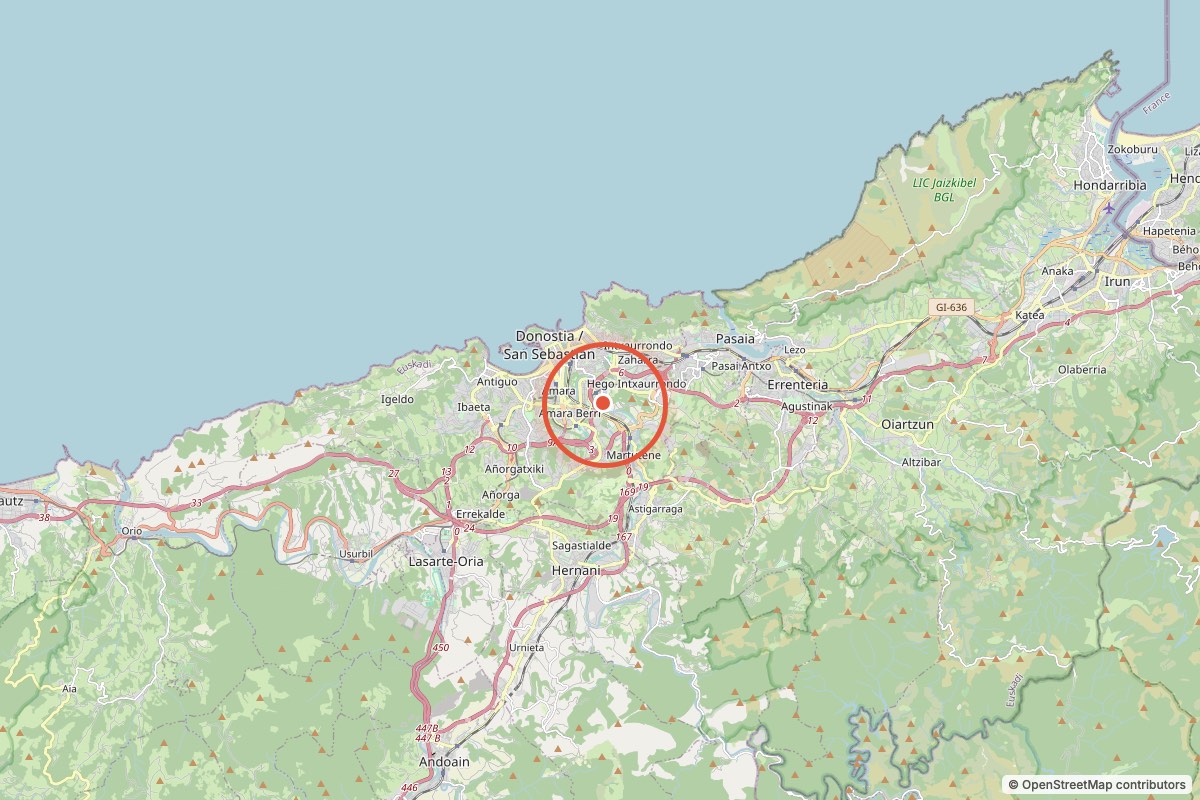
We hear distances all the time — "the fire is 20 miles away", "the stage is 120 miles long", "she lives 1,000 miles from here" — but our brain is bad at picturing them. The map above draws a circle whose radius is the distance you type: everything inside the circle is closer than that distance to the centre, as the crow flies. Type a distance, pick the unit (miles, kilometres or metres) and drag the map to your home or a place you know.
How many kilometres is a mile?
A mile equals 1.609 kilometres (exactly 1,609.344 metres). Conversely, a kilometre is roughly 0.62 miles — which is why metric distances often "don't add up" at first glance.
| Distance | Equivalent |
|---|---|
| 1 mile | 1.609 km · 1,609 m |
| 1 kilometre | 1,000 m · 0.62 miles |
| 100 miles | 160.93 km |
| 100 kilometres | 62.14 miles |
| 1,000 miles | 1,609.34 km |
Straight-line distance examples
To get a sense of the magnitudes (approximate straight-line distances):
- London–Manchester: about 163 miles (262 km)
- London–Edinburgh: about 332 miles (534 km)
- London–Paris: about 214 miles (344 km)
- New York–Los Angeles: about 2,451 miles (3,944 km)
Click any of these figures (or type your own into the tool) and move the map: you will see at a glance how far that distance reaches from the point you choose.
Articles
Frequently asked questions about distances
- How many kilometres is a mile?
- A mile equals 1.609344 kilometres, i.e. about 1,609 metres. Conversely, a kilometre is roughly 0.62 miles. The distance converter turns any amount into miles, kilometres, metres, feet, yards or nautical miles.
- Where do the units of distance come from?
- From two opposite places: from the body and from work (the foot, the inch, the furlong, the league) or from the planet (the metre is one ten-millionth of the quadrant of the Paris meridian). The whole story is in the distance units and where they came from.
- How long is a nautical mile?
- A nautical mile is exactly 1,852 metres (1.852 km, 1.15 statute miles), 15 % longer than a land mile. It matches one minute of arc of a meridian, and a knot is one nautical mile per hour.
- How long is a marathon?
- A marathon is 26.2 miles: 26 miles and 385 yards, or 42.195 kilometres. A half marathon is exactly half of that, 13.11 miles. The figure comes from the 1908 London Olympic course and the IAAF made it official in 1921.
- How far away is the horizon?
- Standing on a beach, with your eyes 5 ft 7 in (1.70 m) above the ground, the horizon is 2.9 miles (4.7 km) away in a straight line, or about 3.1 miles counting the refraction of the air. The formula is d ≈ 1.22 × √h with the eye height in feet: 13 miles from a tenth-floor window and 240 miles from an airliner.
- How can I visualize a distance on a map?
- The most intuitive way is to draw it on a real map, over a place you know. Type the distance in the tool above and the circle will show you how far it reaches.
- What does the circle on the map mean?
- The circle's radius is the distance you entered: everything inside the circle is closer than that distance to the centre, as the crow flies.
- How long does it take to walk a mile?
- At a normal walking pace (about 3 mph), a mile takes around 20 minutes. Three miles is roughly an hour's walk.
Want to visualize areas instead of distances? Try the Hectareometer, which draws how much space any number of hectares takes, or see examples like 1,000 hectares. And for volumes, see how much water any amount of litres really is.