Hectare, acre and fanega: why land was measured in days of work
Published on
A hectare is 10,000 m², an acre 4,046.86 m², and a Spanish fanega depends on the province. Every area unit in one table, and why almost all of them measure a day of work, except the hectare.
See other amounts
A hectare is 10,000 square metres: a square 100 metres on each side. An acre is 4,046.86 square metres, about 0.4 hectares. A Spanish fanega depends on who you ask: 6,459.6 m² in Castile, 3,424 in Madrid, 833 in Valencia. All three measure land, but only one of them came from a ruler; the other two came from a day's work. That is the whole story of area units.
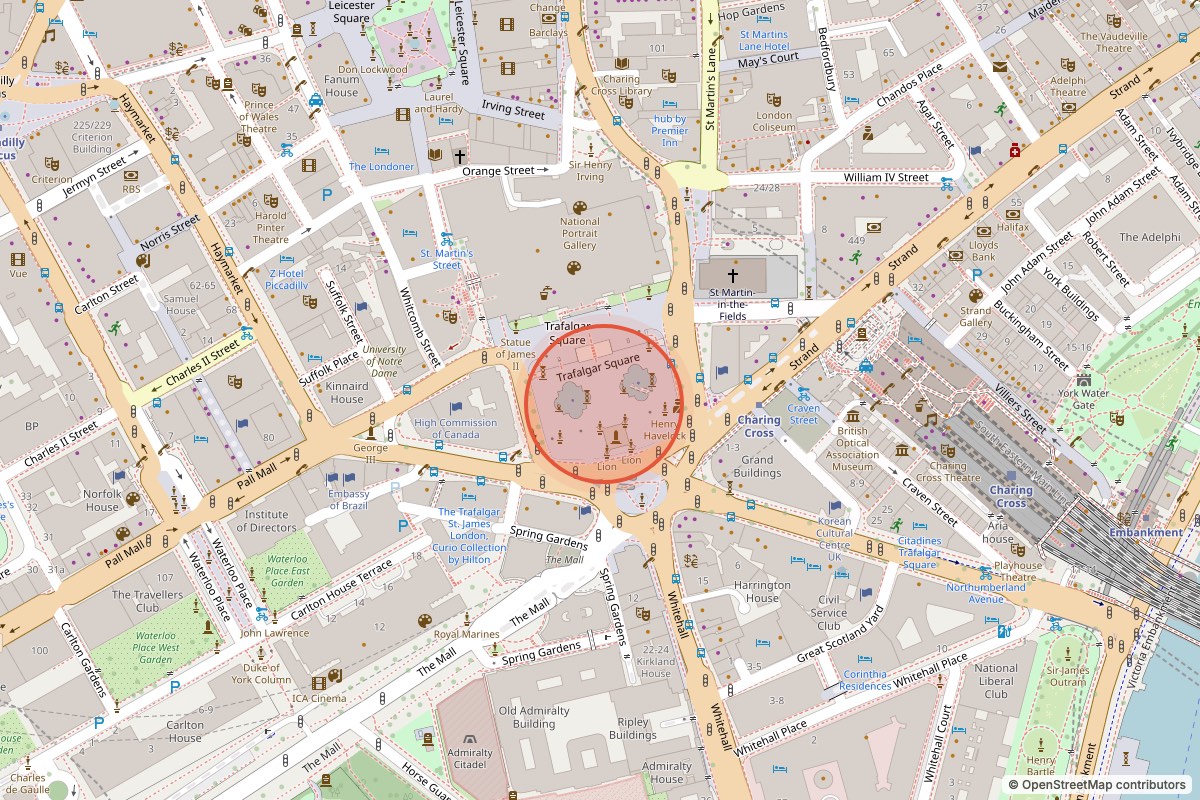
The map above draws one hectare over Trafalgar Square. Compare it with one acre, less than half of it. This article is part of the series on where units come from, together with the distance units. If you only want the number, the area converter does it instantly.
Every area unit at a glance
Each row takes you to the conversion already done or to the area drawn on the map:
| Unit | How much | Where it comes from |
|---|---|---|
| Square metre | 1 m² | The International System unit |
| Are | 100 m² | A 10 × 10 m square; French law of 1795 |
| Hectare | 10,000 m² | A hundred ares: a 100 × 100 m square |
| Square kilometre | 100 ha | A 1 × 1 km square |
| Acre | 4,046.86 m² | What a team of oxen could plough in a day |
| Square mile | 259 ha | 640 acres: the grid of the US land survey |
| Square foot | 0.0929 m² | How US and UK homes are sold |
| Square yard | 0.836 m² | Carpets, turf and old British land plans |
| Decare or dunam | 1,000 m² | Farmland in Greece, Turkey and the Middle East |
| Fanega (Castile) | 6,459.6 m² | The land you can sow with a fanega of grain |
| Football pitch | ~0.71 ha | 105 × 68 m: the informal unit of the news |
Land was measured in days of work
For distances we first measured with the body: the foot, the hand, the pace. Land got something cleverer: it was measured by what it yields. A farmer did not care how many square feet his field had; he wanted to know how long it took to plough and how much seed it needed. So almost every land unit in the world is, underneath, a working day.
The acre is the land a team of oxen could plough in a day. The German Morgen ("morning") is what could be ploughed in a morning. The Spanish yugada is what a yoke of oxen worked in a day. The Egyptian feddan, about 4,200 m², is what a pair of oxen ploughed — and the same Arabic word, faddān, gives the Spanish fanega its meaning as a measure of land. One idea, many languages.
The acre: one furrow long, one chain wide
The English acre has a shape, and it is the shape of a ploughed strip. Its length is a furlong (660 feet, 201 metres) — the furrow long, how far the oxen went before they had to turn and rest. Its width is a chain (66 feet, 20 metres). 660 × 66 = 43,560 square feet. An English statute from around the year 1300 already described it that way: forty perches long by four wide.
That is why the acre is not a round number in any system: it is 4,840 square yards and, since the yard was defined in metres in 1959, exactly 4,046.8564224 square metres. It takes 640 acres to make a square mile (259 hectares), and that is the grid the United States used to parcel out the whole Midwest: what you see from a plane crossing the country is square miles of a land survey drawn with a ruler.
The acre was never one thing, either. The Irish acre was 6,560 m² and the Scottish acre about 5,080, both built on longer local perches. The UK stopped using the acre as a primary unit for trade on 1 October 1995, although farmers and estate agents never let go of it. In the United States it is still the land unit, and until the end of 2022 two slightly different acres coexisted there — the international one and the survey one — about 160 square centimetres apart.
The fanega: a unit of sowing
Spain's traditional land unit shows the same logic even more clearly. The fanega was first a measure of volume, about 55.5 litres of grain. A fanega de tierra is the land you can sow with one fanega of grain — and there is the catch: you do not sow an irrigated valley like a stony dry field, so the land fanega changed with the province, the crop and the soil. Castile's was 6,459.6 m², Extremadura's 6,400, Madrid's 3,424 and Valencia's just 833: a factor of eight between neighbours. It is still heard in rural land sales in Spain today.
The hectare: the only one that did not come from a field
The hectare is the odd one out. It does not measure what somebody ploughs or sows: it is pure geometry. The French law of 18 Germinal Year III (7 April 1795) created the are, from the Latin area: a 10 × 10 metre square, 100 m². A hectare is a hundred ares, a 100 × 100 metre square, chosen because it was the convenient step between the square metre, too small for a farm, and the square kilometre, too big.
Oddly, the hectare is not an SI unit: the SI unit of area is the square metre. But it is so useful that nobody has managed to retire it. It is the legal land unit across the European Union, Australia, Canada, New Zealand, South Africa and, officially, the United Kingdom. Only the United States and Myanmar stick with the acre.
Its great weakness is that nobody can picture it. Nobody has ever seen "a hectare" on its own, which is why the news translates it into football pitches (a hectare is 1.4 of them) — and why this website exists: to draw it over a place you know.
So how big is that in real things?
Hectares make more sense laid over something familiar: see one hectare, 100 hectares or 1,000 hectares drawn to scale on the map, and compare them with a football pitch.
Frequently asked questions about area units
- What are the units of area?
- In the metric system, the square metre and its multiples: the are (100 m²), the hectare (10,000 m²) and the square kilometre (100 ha). In the imperial and US systems, the square foot, the square yard, the acre (4,046.86 m²) and the square mile (259 ha).
- How many square metres are in a hectare?
- A hectare is 10,000 square metres: a square 100 metres on each side, or a hundred ares. A square kilometre is 100 hectares.
- How many hectares is an acre?
- An acre is 0.4047 hectares (4,046.86 square metres), and a hectare is 2.471 acres. It began as the land a team of oxen could plough in a day: one furlong long by one chain wide.
- Why is an acre 43,560 square feet?
- Because it is a furlong (660 feet) by a chain (66 feet): the shape of a strip of ploughed land, as long as the oxen could pull a furrow before resting. 660 × 66 = 43,560. Since 1959 that is exactly 4,046.8564224 square metres.
- Where does the hectare come from?
- From the French metric system. A law of 7 April 1795 created the are, a 10 × 10 metre square, and the hectare is a hundred ares: a 100 × 100 metre square. It is not an SI unit, but it is the legal land unit across the European Union and most of the world.
- Why are old land units all different?
- Because they measured work, not space: the acre and the Spanish yugada were what a team of oxen ploughed in a day, the German Morgen what could be ploughed in a morning, and the Spanish fanega the land sown with a fanega of grain. As the yield changed with the soil, so did the unit. The hectare is the exception: it is pure geometry.
Just want the number? Use the area converter. Want to see it? Type any amount into the Hectareometer and it is drawn to scale over your own city, or measure an area by drawing it on the map yourself. And if you want to know where the metre, the mile and the foot come from, carry on with the distance units.